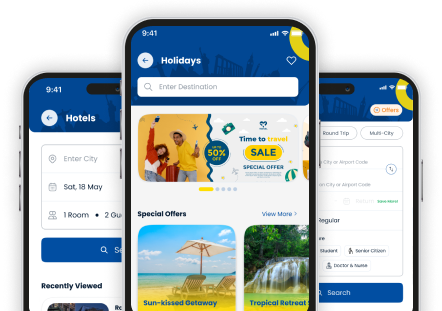



Get Thomas Cook App for
deals on flights, Stay & activities
Download the App Now
We use cookies to improve your website experience and provide more personalized services to you, both on this website and through other media. By continuing to use this website, you agree to our use of cookies as explained in our Cookie Policy. Please read our Cookie Policy for more information on how we use cookies and how you can disable them.
I understandThis has led to a phenomenon known as "The Great Content Treadmill." To keep subscribers engaged, platforms must produce a relentless, never-ending stream of originals. This has resulted in both a golden age of niche programming (shows for every subculture) and a crisis of "choice paralysis," where users spend 10 minutes scrolling instead of watching. Perhaps the most disruptive force in the last decade is the rise of UGC. Platforms like TikTok, Instagram Reels, and Twitch have blurred the line between producer and consumer. In this new paradigm, entertainment and media content is often raw, unpolished, and authentic.
We are living in the era of the "Attention Merchant." Streaming wars (Netflix vs. Disney+ vs. Amazon Prime) are not just wars over IP; they are wars over the user's time. The goal is no longer just to sell a movie ticket, but to reduce "churn"—the rate at which subscribers cancel their memberships.
In the digital age, few sectors have undergone as radical a transformation as the world of entertainment and media content . What was once a one-way street—studios producing films, networks broadcasting shows, and newspapers printing news—has evolved into a dynamic, interactive, and highly personalized ecosystem.
This shift has democratized production. A teenager in their bedroom can produce a documentary that reaches millions, bypassing traditional Hollywood studios. Consequently, the volume of content has exploded. According to recent reports, over 500 hours of video are uploaded to YouTube every minute, and Spotify hosts over 5 million podcasts. Because entertainment and media content is now abundant (and often free), the true currency has become attention . The business model has shifted from sales to subscription and advertising.
Whether it is a holographic concert or a Substack newsletter, the goal remains the same: to connect, to move, and to entertain. In a world of infinite content, authenticity will always be the scarcest resource. Are you keeping up with the rapid changes in entertainment? The only constant is change. Stay curious, stay engaged, and choose your content wisely. yesporn video download hot
Fill in the email Address that you used to register or book with Thomascook.
We will reset and send your new password.
Please enter the valid email address
Your request for new password has been accepted.
The new password would be emailed to the registered email address, if not registered please do the same This has led to a phenomenon known as
This has led to a phenomenon known as "The Great Content Treadmill." To keep subscribers engaged, platforms must produce a relentless, never-ending stream of originals. This has resulted in both a golden age of niche programming (shows for every subculture) and a crisis of "choice paralysis," where users spend 10 minutes scrolling instead of watching. Perhaps the most disruptive force in the last decade is the rise of UGC. Platforms like TikTok, Instagram Reels, and Twitch have blurred the line between producer and consumer. In this new paradigm, entertainment and media content is often raw, unpolished, and authentic.
We are living in the era of the "Attention Merchant." Streaming wars (Netflix vs. Disney+ vs. Amazon Prime) are not just wars over IP; they are wars over the user's time. The goal is no longer just to sell a movie ticket, but to reduce "churn"—the rate at which subscribers cancel their memberships.
In the digital age, few sectors have undergone as radical a transformation as the world of entertainment and media content . What was once a one-way street—studios producing films, networks broadcasting shows, and newspapers printing news—has evolved into a dynamic, interactive, and highly personalized ecosystem.
This shift has democratized production. A teenager in their bedroom can produce a documentary that reaches millions, bypassing traditional Hollywood studios. Consequently, the volume of content has exploded. According to recent reports, over 500 hours of video are uploaded to YouTube every minute, and Spotify hosts over 5 million podcasts. Because entertainment and media content is now abundant (and often free), the true currency has become attention . The business model has shifted from sales to subscription and advertising.
Whether it is a holographic concert or a Substack newsletter, the goal remains the same: to connect, to move, and to entertain. In a world of infinite content, authenticity will always be the scarcest resource. Are you keeping up with the rapid changes in entertainment? The only constant is change. Stay curious, stay engaged, and choose your content wisely.