Home
About Us
Products
Process Models
SE Resources
Commentary
Contact us
|
|
|
Breaking News!
A new blog ...
Private Film 9 Club Private In Seychelles 4 Exclusive Instant
However, the unspoken reason attendees pay upwards of $250,000 per head (accommodation and helicopter transfers included) is . Deals are closed by whispering into underwater phones in the lagoon. Scripts are traded via encrypted USB sticks disguised as seashells.
However, multiple industry trade blogs (including a buried 2024 reference in Variety Insight ) have confirmed that four major Hollywood studios recently filed injunctions to stop a “private screening event in international waters near Mahé.” Furthermore, satellite imagery from Planet Labs shows a temporary structure 200 meters off the coast of a private Seychelles island—a structure that disappears after 14 days.
One attendee from last year’s pilot (who spoke under the condition of anonymity) told us: “I’ve been to the Playboy Mansion and the Met Gala. Neither holds a candle to watching a unreleased Scorsese cut on a beach at 3 AM, knowing that if anyone talks, they’ll be sued into the Mesopelagic zone.” Skeptics have called the Private Film 9 Club an elaborate LARP (Live Action Role Play) for bored billionaires. And indeed, no official website exists. No trailer has ever dropped. The club communicates only via physical letters sealed with wax that contains a unique spectral fingerprint. private film 9 club private in seychelles 4 exclusive
In an era of streaming leaks and TikTok spoilers, the 9 Club offers the one thing money cannot easily buy:
In the world of high-net-worth cinematography and ultra-private media production, there are locations, and then there are sanctuaries . For the past decade, the mysterious collective known only as “The Private Film 9 Club” has remained an enigma—a shadowy fraternity of Oscar-winning directors, A-list cinematographers, and digital auteurs who refuse to let their masterpieces leak before their time. However, the unspoken reason attendees pay upwards of
If you have heard the whispers but couldn’t decipher the code, this article is your backstage pass. Before we dive into the turquoise waters of the Seychelles, let’s decode the name. The “Private Film 9 Club” is not a streaming service nor a traditional studio. It is a nomadic, invitation-only guild founded in 2015 by nine anonymous filmmakers. Their manifesto is simple: Create without compromise; exhibit without exposure.
This year, the club has shattered its silence by unveiling its most ambitious project yet: a hyper-exclusive residency in the heart of the Indian Ocean. Insiders are calling it the —a four-pillar experience that redefines what it means to shoot, screen, and safeguard art. However, multiple industry trade blogs (including a buried
Will we ever see the films screened in Seychelles? Almost certainly not. And that, ironically, is the point. Are you a verified filmmaker with an unreleased masterpiece? Do you have $250,000 in liquid capital and a desire for absolute privacy? Watch the shadows. If the 9 Club wants you, they will find you. For the rest of us, we’ll keep dreaming of that private beach, those four exclusive nights, and the films that will never exist. |
|
|
|
|
|
|
|
|
|
|
|
|
|
|
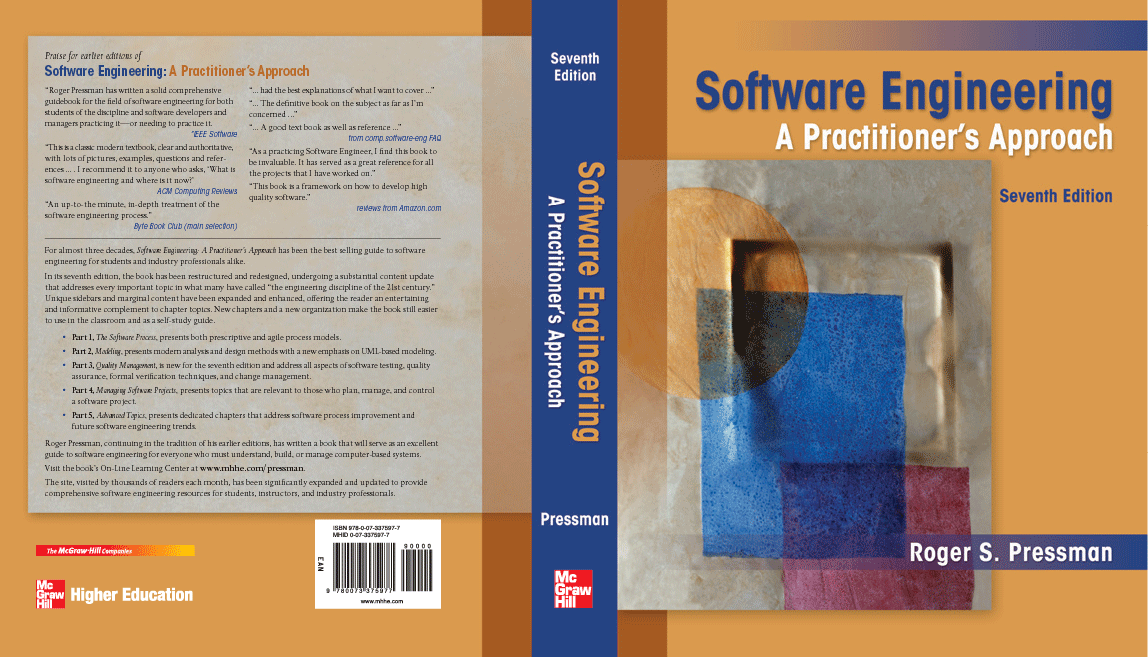
| The newest edition! |
|
 |
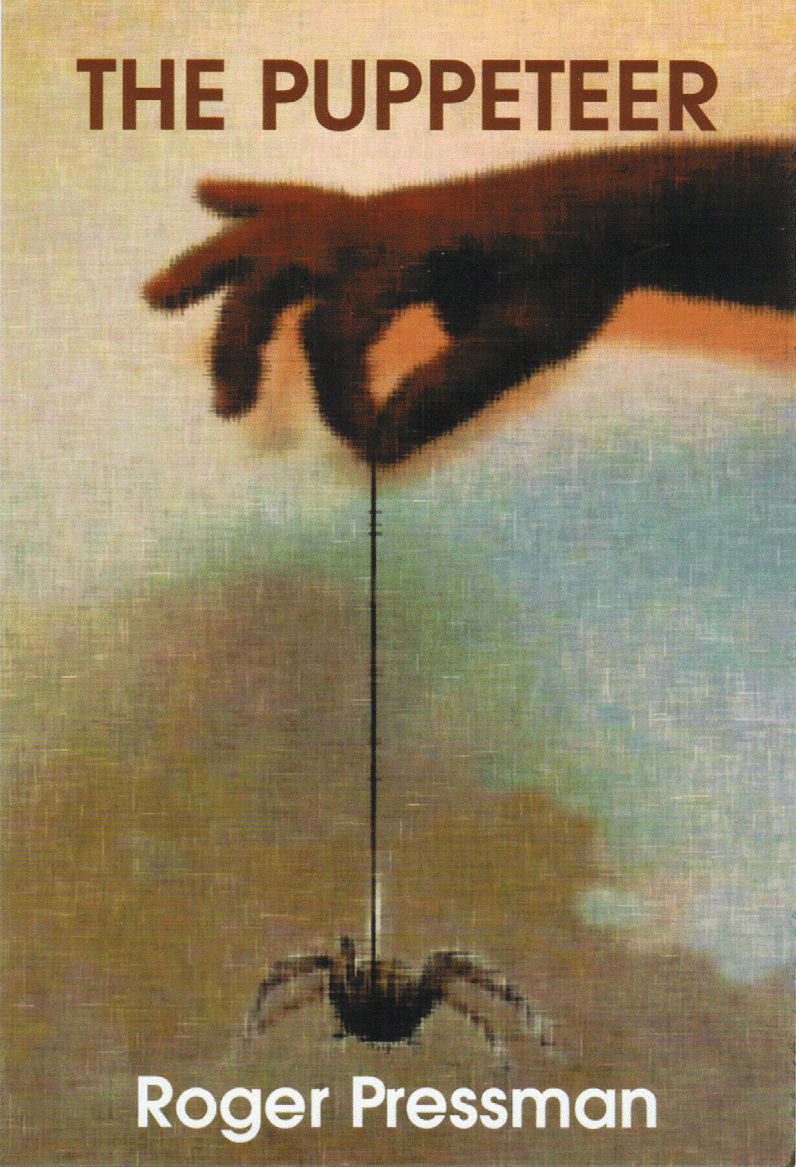
Another novel by
Roger Pressman! |
|
 |
|
|
|
|
|
Available in trade paperback and e-book editions. For more information, click here. |
|
|
|
|
|
|
|
|
|
|
The seventh edition of Software Engineering: A Practitioner's Approach is intended to serve as a guide to a maturing engineering discipline. The seventh edition, like the six editions that preceded it, is intended for both students and practitioners, retaining its appeal as a guide to the industry professional and a comprehensive introduction to the student at the upper level undergraduate or first year graduate level.
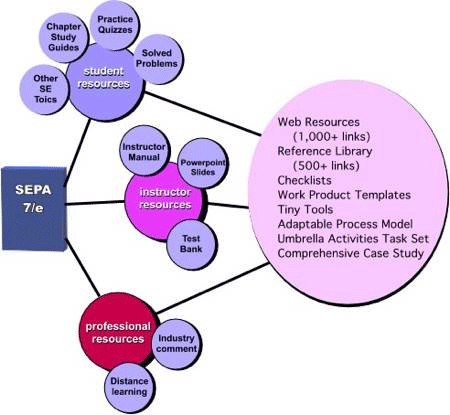
The seventh edition is considerably more than a simple update. The book has been revised and restructured to improve pedagogical flow and emphasize new and important software engineering processes and practices. In addition, a revised and updated “support system,” illustrated below, provides a comprehensive set of student, instructor, and professional resources to complement the content of the book.
|
|
|
|
 |
|
|
The 32 chapters of the seventh edition have been reorganized into five parts. This organization, which differs considerably from the sixth edition, has been done to better compartmentalize topics and assist instructors who may not have the time to complete the entire book in one term.
Part 1, The Process, presents a variety of different views of software process, considering all important process models and addressing the debate between prescriptive and agile process philosophies. Part 2, Modeling, presents analysis and design methods with an emphasis on object-oriented techniques and UML modeling. Pattern-based design and design for Web applications are also considered. Part 3, Quality Management, presents the concepts, procedures, techniques, and methods that enable a software team to assess software quality, review software engineering work products, conduct SQA procedures, and apply an effective testing strategy and tactics. In addition, formal modeling and verification methods are also considered. Part 4, Managing Software Projects, presents topics that are relevant to those who plan, manage, and control a software development project. Part 5, Advanced Topics, considers software process improvement and software engineering trends. Continuing in the tradition of past editions, a series of sidebars is used throughout the book to present the trials and tribulations of a (fictional) software team and to provide supplementary materials about methods and tools that are relevant to chapter topics. Two new appendices provide brief tutorials on UML and object-oriented thinking for those who may be unfamiliar with these important topics.
The five-part organization of the seventh edition enables an instructor to "cluster" topics based on available time and student need. An entire one-term course can be built around one or more of the five parts. A software engineering survey course would select chapters from all five parts. A software engineering course that emphasizes analysis and design would select topics from Parts 1 and 2. A testing-oriented software engineering course would select topics from Parts 1 and 3, with a brief foray into Part 2. A "management course" would stress Parts 1 and 4. By organizing the seventh edition in this way, I have attempted to provide an instructor with a number of teaching options. |
|
|
Software Engineering: A Practitioner's Approach
7th Edition
Table of Contents
Chapters
1. Software and Software Engineering
Part I - Process
2. Process Models
3. Agile Development
Part II - Modeling
4. Practice: A Generic View
5. Understanding Requirements (new chapter)
6. Requirements Modeling: Scenarios and Data (new chapter)
7. Requirements Modeling: Flow, Classes, and Behavior (new chapter)
8. Design Concepts (new chapter)
9. Architectural Design
10. Component-Level Design
11. Usability design (new chapter)
12. Pattern-based Design (new chapter)
13. WebApp Design
Part III - Quality Management
14. Quality Concepts (new chapter)
15. Software reviews (new chapter)
16. Software Quality Assurance
17. Software Testing Strategies
18. Testing Methods for Conventional Software (new chapter)
19. Testing Methods for OO Software (new chapter)
20. Testing Methods for WebApps
21. Advanced Verification Methods (new chapter)
22. Software Configuration Management
23. Product Metrics
Part IV - Project Management
24. Management Concepts
25. Process and Project Metrics
26. Estimation
27. Scheduling
28. Risk Management
29. Maintenance and Reengineering (new chapter)
Part V-Advanced Topics
30. Software Process improvement (new chapter)
31. Emerging Trends in Software Engineering (new chapter)
32. The Road Ahead
Appendix I - UML Tutorial (new)
Appendix II - OO Concepts (new)
|
|
|
|
|
|
|
|
|
Home About us Products Product Models SE Resources Commentary Contact us
Web site and all contents © 2001-2009, R.S. Pressman & Associates, Inc., All rights reserved.
Free website templates
|
|