Attribution Creative Commons Noncommercial No Derivatives Share Alike Zero

Isekai: Bastard -v0.1.1d- Irta- Bastard-sama

Data miners found a secret text file in the game’s directory labeled READ_ME_IRTA.txt . It contains a monologue where Irta admits that she is the original Bastard-Sama. The player is merely a puppet used to reset the timeline. Every time you betray someone in the game, you are actually reliving her original sin.

Critics have called this mechanic "morally bankrupt." The developer counters that it is "an honest exploration of power fantasy without the filter of heroism." One of the most discussed elements of the Isekai Bastard community is the "Irta Paradox," a piece of hidden lore discovered in v0.1.1d. Isekai Bastard -v0.1.1d- Irta- Bastard-Sama

However, the goddess isn't a benevolent figure. Irta is a cosmic bureaucrat who dumps you into a high-fantasy world on the brink of collapse, but with a twist: She gives you the "Bastard Class"—a set of skills that only activate when you behave selfishly, cruelly, or dishonorably. Data miners found a secret text file in

Just remember: In the world of Irta, there are no heroes. There is only Bastard-Sama. And you are the worst one yet. Final Rating (Early Access): Verdict: A brilliantly written, mechanically crude love letter to bad decisions. Watch for the full release of v0.2, which promises the "Irta Redemption Route." Bastard-Sama, we await your next betrayal. Every time you betray someone in the game,

Enter , the latest early-access build from the notoriously anonymous developer known only as "Rogue Vector." Currently sitting at version 0.1.1d, this demo is already generating significant buzz (and controversy) for its unapologetic anti-hero, its dense lore surrounding the "Irta" systems, and the title character known simply as Bastard-Sama.

Here is everything you need to know about the build, the world, and why "Irta" might be the most dangerous magic system since Wild Magic. At its core, Isekai Bastard is a dark comedy visual novel with light resource management and turn-based combat. The premise is deceptively simple: You die on Earth in a humiliating fashion (the demo offers three prologues: "Crushed by a vending machine," "Struck by lightning while cheating," or "Betrayed by your waifu body pillow") and are reincarnated by a drunk goddess named Irta .

The Isekai genre has been saturated with overpowered heroes carrying cheat skills and moral superiority. But every so often, a title emerges from the indie development scene that dares to ask: “What if the protagonist was the problem?”
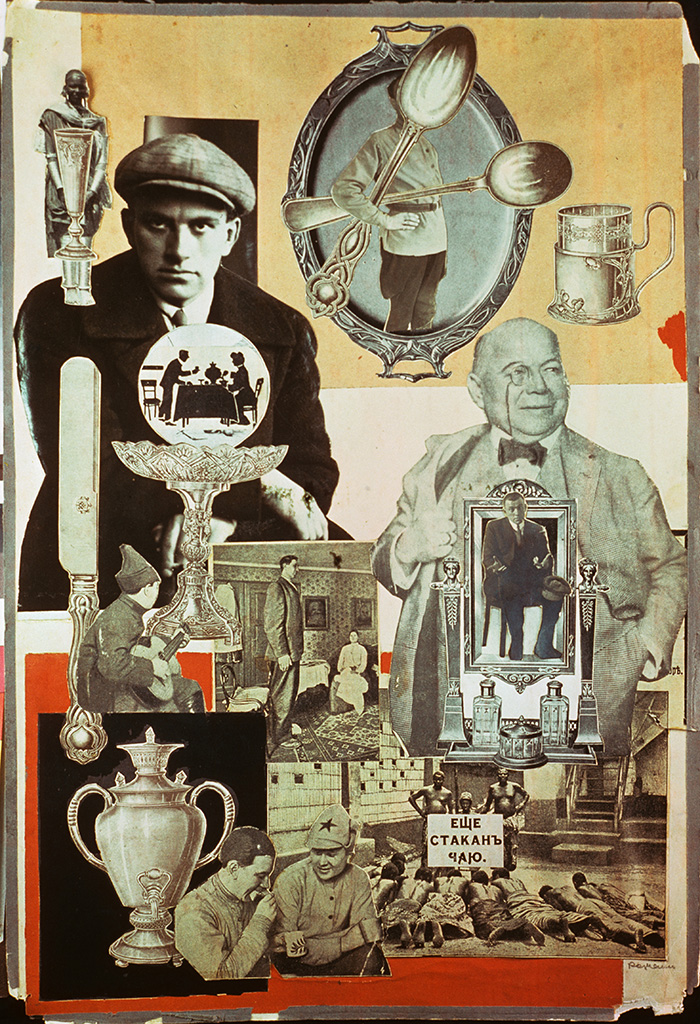
Fig. 1. — Brigade KGK (Viktor Koretsky [1909–98], Vera Gitsevich [1897–1976], and Boris Knoblok [1903–84]). “We had to overcome among the people in charge of trade the unhealthy habit of distributing goods mechanically; we had to put a stop to their indifference to the demand for a greater range of goods and to the requirements of the consumers.” From the 16th to the 17th Congress of the All-Union Communist Party (Bolsheviks), 1934, no. 57, gelatin silver print, 22.7 × 17 cm. Los Angeles, Getty Research Institute, 2014.R.25.
Fig. 2. — Brigade KGK (Viktor Koretsky [1909–98], Vera Gitsevich [1897–1976], and Boris Knoblok [1903–84]). “There is still among a section of Communists a supercilious, disdainful attitude toward trade in general, and toward Soviet trade in particular. These Communists, so-called, look upon Soviet trade as a matter of secondary importance, not worth bothering about.” From the 16th to the 17th Congress of the All-Union Communist Party (Bolsheviks), 1934, no. 56, gelatin silver print, 22.7 × 17 cm. Los Angeles, Getty Research Institute, 2014.R.25.
Collage of photographs showing Vladimir Mayakovsky surrounded by a silver samovar, cutlery, and trays; two soldiers enjoying tea; a giant man in a bourgeois parlor; and nine African men lying prostrate before three others who hold a sign that reads, in Cyrillic letters, “Another cup of tea.”
Fig. 3. — Aleksandr Rodchenko (Russian, 1890–1956). Draft illustration for Vladimir Mayakovsky’s poem “Pro eto,” accompanied by the lines “And the century stands / Unwhipped / the mare of byt won’t budge,” 1923, cut-and-pasted printed papers and gelatin silver photographs, 42.5 × 32.5 cm. Moscow, State Mayakovsky Museum. Art © 2024 Estate of Alexander Rodchenko / UPRAVIS, Moscow / ARS, NY. Photo: Art Resource.
Fig. 4. — Boris Klinch (Russian, 1892–1946). “Krovovaia sobaka,” Noske (“The bloody dog,” Noske), photomontage, 1932. From Proletarskoe foto, no. 11 (1932): 29. Los Angeles, Getty Research Institute, 85-S956.
Fig. 5. — Brigade KGK (Viktor Koretsky [1909–98], Vera Gitsevich [1897–1976], and Boris Knoblok [1903–84]). “We have smashed the enemies of the Party, the opportunists of all shades, the nationalist deviators of all kinds. But remnants of their ideology still live in the minds of individual members of the Party, and not infrequently they find expression.” From the 16th to the 17th Congress of the All-Union Communist Party (Bolsheviks), 1934, no. 62, gelatin silver print, 22.7 × 17 cm. Los Angeles, Getty Research Institute, 2014.R.25.
Fig. 6. — Brigade KGK (Viktor Koretsky [1909–98], Vera Gitsevich [1897–1976], and Boris Knoblok [1903–84]). “There are two other types of executive who retard our work, hinder our work, and hold up our advance. . . . People who have become bigwigs, who consider that Party decisions and Soviet laws are not written for them, but for fools. . . . And . . . honest windbags (laughter), people who are honest and loyal to Soviet power, but who are incapable of leadership, incapable of organizing anything.” From the 16th to the 17th Congress of the All-Union Communist Party (Bolsheviks), 1934, no. 70, gelatin silver print, 22.7 × 17 cm. Los Angeles, Getty Research Institute, 2014.R.25.
Fig. 7. — Artist unknown. “The Social Democrat Grzesinski,” from Proletarskoe foto, no. 3 (1932): 7. Los Angeles, Getty Research Institute, 85-S956.
Fig. 8A. — Pavel Petrov-Bytov (Russian, 1895–1960), director. Screen capture from the film Cain and Artem, 1929. Image courtesy University of California, Berkeley, Berkeley Art Museum and Pacific Film Archive Library.
Fig. 8B. — Pavel Petrov-Bytov (Russian, 1895–1960), director. Screen capture from the film Cain and Artem, 1929. Image courtesy University of California, Berkeley, Berkeley Art Museum and Pacific Film Archive Library.
Fig. 8C. — Pavel Petrov-Bytov (Russian, 1895–1960), director. Screen capture from the film Cain and Artem, 1929. Image courtesy University of California, Berkeley, Berkeley Art Museum and Pacific Film Archive Library.
Fig. 9. — Herbert George Ponting (English, 1870–1935). Camera Caricature, ca. 1927, gelatin silver prints mounted on card, 49.5 × 35.6 cm (grid). London, Victoria and Albert Museum, RPS.3336–2018. Image © Royal Photographic Society Collection / Victoria and Albert Museum, London.
Fig. 10. — Aleksandr Zhitomirsky (Russian, 1907–93). “There are lucky devils and unlucky ones,” cover of Front-Illustrierte, no. 10, April 1943. Prague, Ne Boltai! Collection. Art © Vladimir Zhitomirsky.
of